SecureNow vs Traditional SIEM: Why Trace-Based Security Wins for Modern Applications
A detailed comparison of trace-based application security monitoring versus traditional SIEM — covering detection fidelity, false positive rates, time-to-detection, and total cost of ownership.

SecureNow vs Traditional SIEM: Why Trace-Based Security Wins for Modern Applications
Security Information and Event Management systems have been the backbone of enterprise security operations for over two decades. They collect logs from firewalls, servers, endpoints, and applications, aggregate them into a centralized store, and apply correlation rules to detect threats. For infrastructure security, compliance reporting, and log retention, SIEMs remain indispensable.
But something has changed about how modern applications work, and SIEMs have not kept up.
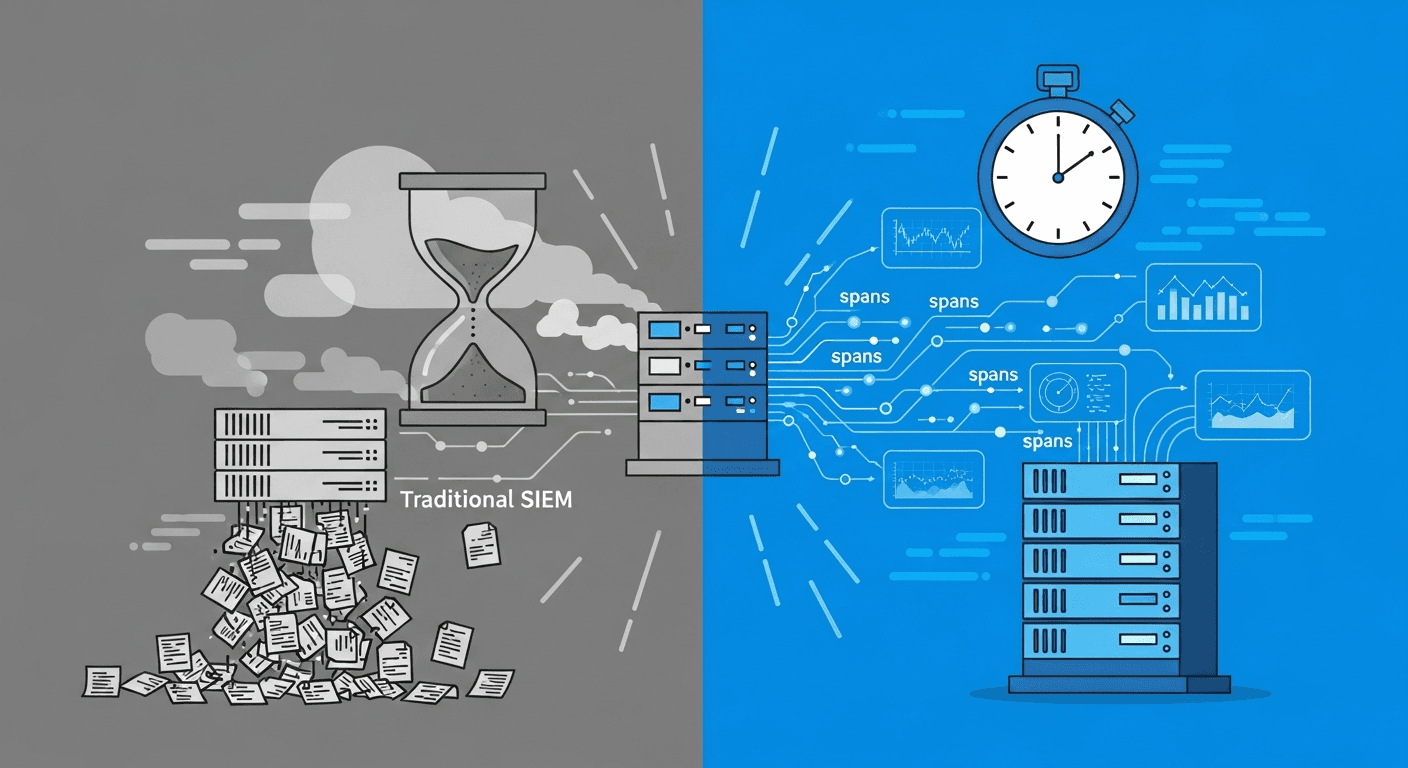
Applications today are distributed across dozens or hundreds of microservices. A single user action generates a cascade of HTTP calls, database queries, cache lookups, message queue interactions, and third-party API requests spanning multiple services and infrastructure layers. A traditional SIEM sees this as a collection of individual log lines — disconnected events with no causal relationship, no timing context, and no understanding of the request flow that connects them.
This is the structural limitation that trace-based security monitoring addresses. Distributed traces capture the full lifecycle of every request — every span, every service hop, every database query, every response — as a single, connected graph with timing relationships and structured metadata. When you monitor security at the trace level rather than the log level, you see attacks the way they actually happen: as sequences of operations flowing through your application.
This analysis compares the two approaches honestly. SIEMs have real strengths. Trace-based monitoring has real limitations. The question is not which tool is universally better — it is which approach matches the threat model of modern, API-driven applications.
The SIEM Problem: Death by Logs
The SIEM model was designed for a simpler era. When your application was a monolith running on a few servers behind a load balancer, the log volume was manageable and the correlation was straightforward. A firewall log, a web server access log, and an application error log could be joined by timestamp and IP address to reconstruct most incidents.
Modern applications break this model in several ways.
Volume overwhelms analysis. A microservices architecture with 30 services, each generating structured and unstructured logs, easily produces hundreds of gigabytes per day. At SIEM pricing of $5-15 per GB per day (typical for major vendors), log ingestion alone costs tens of thousands of dollars monthly. Organizations respond by filtering — ingesting only "important" logs — which introduces blind spots that attackers exploit.
Flat logs lack context. A log line reading POST /api/users/login 401 — 192.168.1.100 tells you that a login failed. It does not tell you what the application did in response — whether the failure triggered a lockout check, whether the IP has a session with successful logins on other endpoints, or whether the request originated from an authenticated session attempting lateral movement. That context exists in traces but not in logs.
Correlation rules are brittle. SIEM detection logic relies on correlating events across log sources using shared identifiers like IP addresses, timestamps, and user IDs. In a microservices environment where a single request touches twelve services, the correlation logic required to reconstruct the request path is extraordinarily complex and fragile. A timestamp skew of a few milliseconds across services can break correlations entirely.
False positive rates are devastating. Gartner research has consistently identified alert fatigue as one of the top challenges facing SOC teams. Traditional SIEM rule engines, operating on incomplete log data with pattern-matching logic, generate false positive rates that routinely exceed 90% for application-layer detection rules. Analysts spend most of their time dismissing noise rather than investigating real threats.
Query performance degrades at scale. Investigating an incident in a SIEM often means searching through terabytes of unstructured or semi-structured log data. Complex queries can take minutes or hours to execute, turning real-time incident response into an archaeological exercise.
The Trace-Based Approach: Structured Data, Causal Context
Distributed traces, generated by OpenTelemetry instrumentation, fundamentally change the data model for security monitoring. Instead of flat text events, you get a structured graph of operations with explicit parent-child relationships, precise timing data, and rich metadata.
A single HTTP request to your application might generate a trace with thirty spans: the ingress handler, authentication middleware, authorization check, three database queries, two cache lookups, an outbound API call, and the response serialization. Each span records its operation name, duration, status, and custom attributes. Database spans record the SQL statement. HTTP client spans record the URL. Error spans record the exception type and message.
This structured data enables detection approaches that are impossible with logs:
Causal analysis. Traces show that Span A caused Span B, which caused Span C. If Span A is an HTTP request from an external IP, Span B is a database query containing SQL injection, and Span C is an outbound HTTP call to an attacker-controlled host, the trace captures the entire attack chain as a single, connected graph. A SIEM would see three separate log entries with no explicit causal link.
Timing-based detection. Span durations and inter-span gaps reveal behavioral patterns. Credential stuffing bots produce traces with suspiciously uniform timing. Brute-force attacks show rapid sequential authentication spans. Data exfiltration produces unusually long-running export spans. These timing signals exist in traces natively but must be reconstructed from log timestamps with far less precision.
Request-flow anomaly detection. When your application always processes requests in the pattern Auth → Validate → Query → Respond, a trace that shows Query → Auth (or skips Auth entirely) is an immediate anomaly. Traces make this visible because the span hierarchy is explicit. Logs cannot reliably reconstruct this flow.
Structured metadata enables precise queries. Querying traces for "all requests where the database span contains UNION SELECT and the response status is 200" is a precise, low-false-positive detection. The equivalent SIEM query — searching unstructured log text for SQL injection patterns — catches a vastly larger number of benign matches.
Side-by-Side Comparison
The following comparison evaluates SIEM and trace-based security across the dimensions that matter most for application security operations.
| Capability | Traditional SIEM | SecureNow (Trace-Based) |
|---|---|---|
| Data model | Flat log events (text/JSON) | Structured trace graphs with span hierarchies |
| Detection fidelity | Pattern matching on log text | Behavioral analysis on structured operations |
| False positive rate | High (80-95% for app-layer rules) | Low (structured data enables precise matching) |
| Time to detection | Minutes to hours (query latency) | Minutes (SQL on ClickHouse columnar storage) |
| Request-flow visibility | None (must reconstruct from logs) | Native (trace spans show full request lifecycle) |
| Causal relationships | Inferred from timestamps/IDs | Explicit parent-child span relationships |
| AI analysis | Limited (text-based anomaly detection) | Deep (AI analyzes structured trace graphs for attack patterns) |
| Query language | Vendor-specific (SPL, KQL, etc.) | SQL + natural language (NL-to-SQL forensics) |
| Setup time | Weeks to months | Hours to days |
| Cost model | Per GB of log ingestion ($5-15/GB/day) | Per TB of trace storage ($5/TB) |
| Infrastructure monitoring | Strong | Not primary focus |
| Compliance log retention | Strong | Complementary |
| Application-layer detection | Weak | Strong |
Where SIEMs Still Win
Honesty about limitations matters more than marketing claims. There are domains where traditional SIEMs remain the better choice.
Infrastructure and network security. Firewall logs, IDS/IPS alerts, VPN access logs, and endpoint detection data are log-native. These data sources do not generate traces, and SIEMs are purpose-built to aggregate, correlate, and alert on them. If your primary concern is network perimeter security, a SIEM is the right tool.
Compliance and audit log retention. Regulatory frameworks like SOC 2, PCI DSS, and HIPAA often specify log retention requirements in terms that map directly to SIEM capabilities — centralized log collection, tamper-evident storage, and access audit trails. SIEMs have decades of compliance certification and auditor familiarity.
Multi-source correlation. When the detection use case requires correlating events across fundamentally different data sources — a VPN login from an unusual country, followed by a badge-in at the office, followed by a large file download — SIEMs are designed for this cross-domain correlation that no application-level tool can replicate.
Vendor ecosystem. SIEMs integrate with hundreds of data sources through pre-built connectors. Security orchestration platforms, threat intelligence feeds, and ticketing systems all have mature SIEM integrations. This ecosystem is a real operational advantage for teams that need turnkey connectivity.
Where Traces Win Decisively
For application-layer security — the threats that target your APIs, exploit your business logic, and abuse your authentication flows — trace-based monitoring offers capabilities that SIEMs fundamentally cannot match.
SQL injection, SSRF, and application-layer attacks. These attacks execute inside your application. A SIEM sees the HTTP request and the response status code. SecureNow's AI trace analysis sees the actual database query that was executed, the outbound connection that was made, and the file path that was accessed. The difference between seeing the door and seeing what happened inside the room.
Authentication and authorization bypass. When an attacker finds a way to skip authentication middleware or escalate privileges through a flawed authorization check, the trace captures the missing or anomalous spans. A SIEM would need application-specific log parsing and correlation rules that must be rebuilt for every application — and even then would lack the span-level visibility.
API abuse and bot detection. Modern applications expose APIs that are targeted by credential stuffing, account takeover, and automated abuse campaigns. Traces capture request timing, endpoint targeting patterns, parameter distributions, and error rate characteristics that enable behavioral detection. SecureNow's quadrant analysis visualizes these patterns across all IPs simultaneously — a capability with no SIEM equivalent.
Root cause analysis. When a SIEM alert fires, the investigation typically requires searching through multiple log sources, mentally reconstructing the request flow, and jumping between tools. When a SecureNow notification fires, the investigation starts from the trace — the complete request lifecycle is already captured, the AI investigation has already analyzed it, and the forensic query interface lets analysts ask follow-up questions in natural language.
False positive management. SecureNow's false positive management system uses AI-suggested exclusion patterns, test-before-apply validation, and cross-notification application. SIEM false positive management typically consists of modifying correlation rules — a process that requires specialized expertise and carries the risk of breaking detection logic.
The Cost Equation
Cost is often the deciding factor for security tool decisions, and the economics of SIEM versus trace-based monitoring differ dramatically.
SIEM cost structure. Major SIEM vendors charge per gigabyte of ingested log data, with pricing typically ranging from $5 to $15 per GB per day. An application generating 100 GB of logs per day incurs $150,000 to $547,500 in annual ingestion costs alone, before accounting for storage, compute, professional services, and analyst time. Many organizations respond by reducing log volume — dropping verbose debug logs, sampling high-volume sources, or excluding entire data sources — which directly reduces detection coverage.
Trace-based cost structure. SecureNow stores traces in ClickHouse at $5 per TB of storage. Traces are inherently more efficient than logs because they are structured data with explicit schemas, enabling columnar compression that reduces storage volume by 5-10x compared to raw log text. More importantly, traces contain higher signal density — every span is a meaningful operation with typed attributes, whereas a significant percentage of log data is formatting, repetition, and low-value events.
The hidden cost: analyst time. Beyond licensing, the largest security monitoring cost is analyst time. SIEMs with high false positive rates consume analyst hours in triage work that produces no security value. SecureNow's structured data, AI investigation, and false positive management reduce triage time by limiting the volume of noise that reaches human analysts. The notification triage workflow is designed specifically to minimize the time between alert and verdict.
Total cost comparison. For a mid-size application team ingesting 50 GB of log data per day into a SIEM at $10/GB/day, the annual SIEM cost for application log monitoring alone is approximately $182,500. SecureNow monitoring the same application's trace data (which compresses to a fraction of the log volume) costs significantly less while providing substantially better application-layer detection.
The Complementary Architecture
The most effective security architectures do not choose between SIEM and trace-based monitoring. They use both, each covering the domain where it excels.
SIEM handles: network perimeter events, firewall and IDS/IPS alerts, endpoint detection, VPN and access management, compliance log retention, infrastructure security monitoring, and cross-domain correlation.
SecureNow handles: application-layer attack detection, API abuse and bot campaigns, authentication and authorization anomalies, SQL injection and SSRF in production, AI-powered trace and IP investigation, forensic analysis of application behavior, false positive management, and API attack surface mapping.
This division follows the natural boundary between infrastructure and application security. Your SIEM tells you that someone logged into the VPN from an unusual location. SecureNow tells you what that someone did inside your application after they got in.
The NIST Cybersecurity Framework advocates for defense-in-depth — layered security controls that compensate for each other's limitations. SIEM and trace-based monitoring are complementary layers, each covering blind spots in the other. A SIEM alone misses application-layer attacks that happen inside legitimate sessions. Trace monitoring alone misses infrastructure-level threats that never reach the application. Together, they provide comprehensive coverage.
Making the Transition
Adding trace-based monitoring does not require a disruptive migration. Most teams start by instrumenting their most critical application with OpenTelemetry and connecting SecureNow to their ClickHouse instance — a process that takes a single day. See the complete SecureNow workflow guide for the step-by-step process.
From there, the transition is incremental: build initial alert rules for application-layer threats your SIEM handles poorly, then shift application-specific log ingestion out of the SIEM as trace-based detection proves itself, and finally layer in AI investigation, forensic queries, and API Map Discovery for capabilities that have no SIEM equivalent.
The goal is not to replace your SIEM. It is to stop asking your SIEM to do something it was never designed to do — monitor the internal behavior of modern, distributed applications.
The Verdict
Traditional SIEMs are essential infrastructure tools that will remain in enterprise security stacks for the foreseeable future. Their strengths in log aggregation, compliance, and cross-domain correlation are genuine and well-earned.
But for application security — the attacks that target your APIs, exploit your business logic, and abuse your user-facing endpoints — SIEMs are using the wrong data model. Flat logs cannot capture the structured, causal, time-sequenced nature of application behavior that distributed traces capture natively.
SecureNow is built on the conviction that application security monitoring should operate on application data: traces, spans, and the rich metadata that OpenTelemetry makes available. When your detection logic operates on the same data that your application actually produces, the result is higher fidelity detection, lower false positive rates, faster investigations, and dramatically lower cost.
The applications you build today deserve security monitoring designed for how they actually work — not adapted from tools built for a different era.
Frequently Asked Questions
Does SecureNow replace a SIEM?
SecureNow complements traditional SIEMs rather than replacing them. SIEMs excel at infrastructure-level log aggregation and compliance, while SecureNow provides application-level trace analysis that SIEMs cannot offer.
Why are traces better than logs for application security?
Traces capture the full request lifecycle with causal relationships between services, timing data, and structured metadata. Logs are flat text events that lack context about request flow and inter-service communication.
What's the cost difference between SecureNow and a SIEM?
Traditional SIEMs charge per GB of log ingestion ($5-15/GB/day). SecureNow's trace-based approach is more efficient because structured traces contain higher signal density than raw logs, reducing data volume while increasing detection quality.
Can I use SecureNow and a SIEM together?
Absolutely. Many organizations use SecureNow for application-layer security and their SIEM for infrastructure, network, and compliance. The combination provides comprehensive coverage across all layers.
Frequently Asked Questions
Does SecureNow replace a SIEM?
SecureNow complements traditional SIEMs rather than replacing them. SIEMs excel at infrastructure-level log aggregation and compliance, while SecureNow provides application-level trace analysis that SIEMs cannot offer.
Why are traces better than logs for application security?
Traces capture the full request lifecycle with causal relationships between services, timing data, and structured metadata. Logs are flat text events that lack context about request flow and inter-service communication.
What's the cost difference between SecureNow and a SIEM?
Traditional SIEMs charge per GB of log ingestion ($5-15/GB/day). SecureNow's trace-based approach is more efficient because structured traces contain higher signal density than raw logs, reducing data volume while increasing detection quality.
Can I use SecureNow and a SIEM together?
Absolutely. Many organizations use SecureNow for application-layer security and their SIEM for infrastructure, network, and compliance. The combination provides comprehensive coverage across all layers.
Recommended reading
A practical, developer-focused walkthrough of the OWASP API Security Top 10 (2023) — what each risk means, how to spot it in your code, and a free AI prompt to audit your API against all ten.
Jul 17We deployed a real Next.js app to AWS, connected SecureNow traces, logs, body capture, multipart metadata, and firewall, then used an AI-assisted MCP workflow to block the attacker IP.
May 18A prioritized checklist of web development security best practices for Node.js teams, from secure coding to production monitoring and incident response.
May 12